Preserve the contextClear checkout. Clear confirmation. Clear next step.↗
Design around how the buyer arrived.Journey reconstruction
The commercial question
An operating model has to remain intelligible at the moment a customer commits.
A customer arriving directly through Revion and a customer arriving from another storefront begin with different context. The product work separated those journeys and made the brand, checkout and order experience follow the right path.
Relationship
Venture / operating engagement
Period
May 2026 journey redesign and subsequent brand work
Stage / evidence
Brand system and checkout implementation
Project focusBrand + transaction journey
The identity, entry route, checkout and order experience.
Decisive changeSeparate customer paths
Direct-brand and partner-originated journeys modelled explicitly.
EvidenceIdentity + implementation
Original brand handover, journey specification and checkout code.
Papers attached · source, period & limits
This is a record of brand and product work. It does not establish current transaction availability, bank or regulatory approval, commercial scale or investment performance.
01 · The problem
The entry route changes what a customer needs to know.
An early version combined a direct Revion storefront journey with a handoff intended for customers arriving from a separate storefront. The resulting experience mixed two different starting contexts. A brand change alone could not resolve that product question.
02 · The decision
Model the two journeys explicitly.
The revised architecture treated direct-brand and partner-originated purchases as separate paths. A direct Revion customer could stay within the Revion journey. A customer arriving from another storefront had a distinct transition into checkout. Each path had to carry the right purchase context into the order experience.
03 · The work
Carry the decision through every consequential screen.
The change affected the cart, checkout, confirmation and customer communications, as well as the supporting order records. The work connected visible language to system behaviour: where a customer arrived, what they were buying, who they were purchasing from and where to go for support.
04 · The identity
Make the infrastructure recognisable.
The Revion symbol, wordmark and blue identity field give the product a consistent visual presence. They belong to the same design problem as the transaction journey: the business a customer encounters should remain clear from introduction through the order experience.
The decision, made visible
Before. The move. After.
Explanatory reconstruction from the product specification and implementation record.
01Starting condition
Direct customers and referred customers shared a mixed handoff.
02The intervention
Separate the entry paths and align each with its checkout context.
03Resulting design / evidence
Documented journeys connect entry, purchase and confirmation consistently.
The work, inspectable
The artifacts behind the account.
Each artifact is labelled for what it is: an original, a historical report, or our reconstruction.
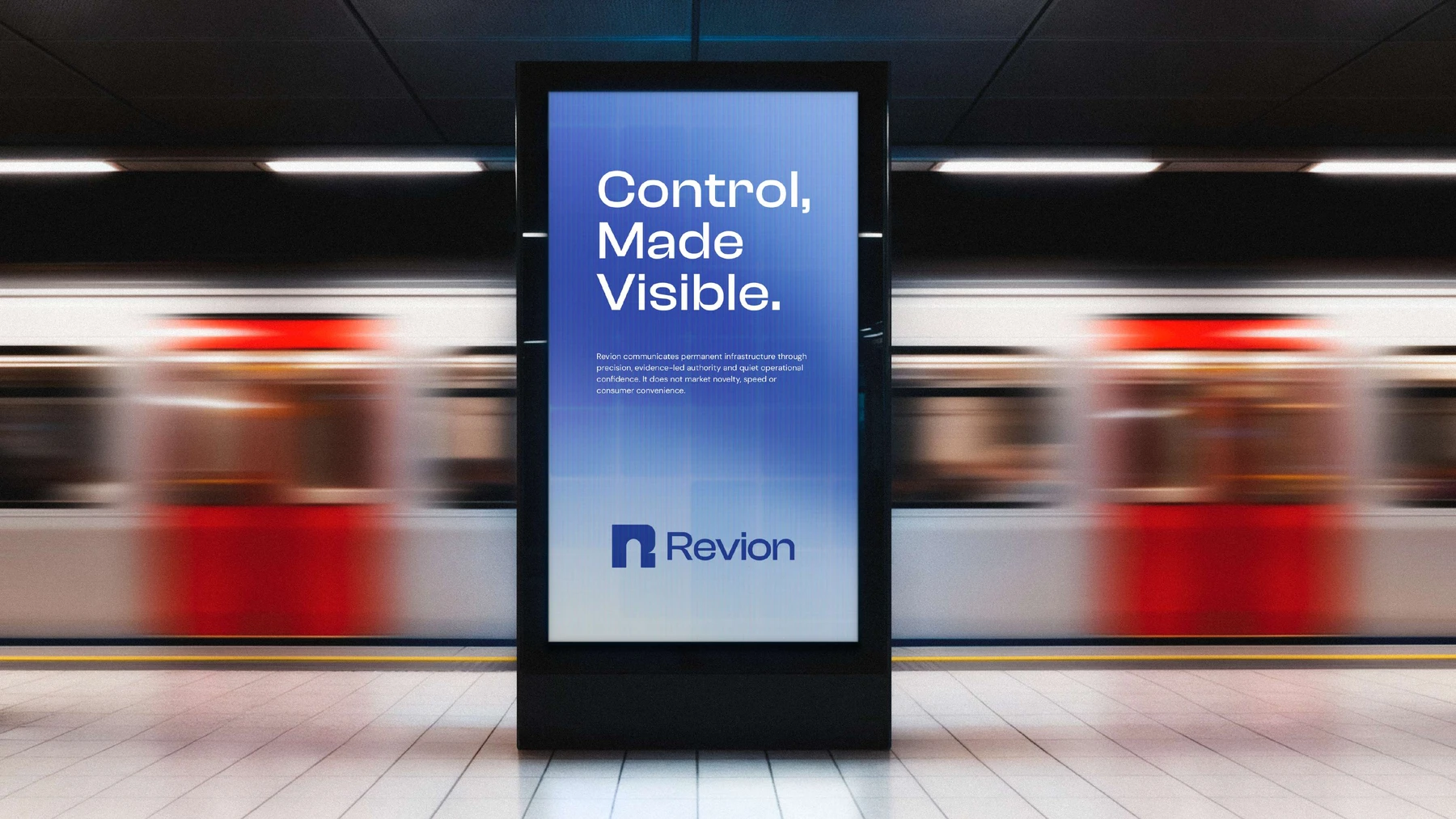
Environmental applications explore how the identity behaves outside the product interface.
Original environmental identity concept.Explanatory reconstruction
Different entry contexts. Explicit journeys.
The same purchase experience must account for the context a customer brings into it.
Simplified editorial reconstruction of a documented product decision. It is not a live checkout or an approval claim.
What the work establishes
A specific architecture decision, carried into the build.
The retained specification records the journey decision, and the implementation carries the direct Revion path from cart into checkout. The original identity assets establish the accompanying brand system. Together they show product reasoning made concrete in the experience and its supporting implementation.